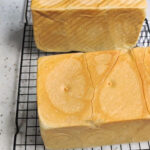
Pure Milk Sandwich Bread Recipe (Soft, Fluffy & Perfect for Sandwiches)
This bakery-style milk sandwich bread is rich, fluffy, and beautifully stretchy. Using pure milk dough with eggs, milk powder, and butter, the loaf bakes up soft with a fine, even crumb—perfect for sandwiches, toast, or tearing by hand. A dependable homemade bread you’ll bake again and again.
Servings 8
Calories 272kcal
Ingredients
- 260 g bread flour
- 100 g whole eggs about 2 large, room temperature
- 380 g whole milk warmed to about 30°C (85°F)
- 20 g full-fat milk powder
- 60 g unsalted butter softened
- 80 g granulated sugar
- 4 g fine sea salt
- 8 g instant yeast
Instructions
Mix Ingredients and Initial Kneading
- Add the bread flour, eggs, milk, sugar, salt, milk powder, and yeast to the stand mixer bowl in sequence. Make sure the yeast is kept separate from the salt and sugar to avoid reducing its activity.
- Mix on low speed for 1 minute until everything comes together into a rough dough. Increase to high speed and knead for 7–8 minutes, until the dough becomes cohesive and can be stretched into a thick membrane. At this stage, the dough may tear with slightly rough edges.
Add Butter and Knead to Windowpane
- Add the softened butter to the dough and continue kneading on high speed for about 10 minutes. The dough should become smooth, elastic, and capable of stretching into a thin, translucent windowpane with smooth tear edges. Shape the dough lightly into a round.
- To test if the gluten is fully developed, take a small piece of dough and gently stretch it between your fingers. It should stretch into a thin, translucent membrane without tearing immediately. This is the "windowpane" stage and is key for the bread's texture.
First Fermentation
- Return the dough to the mixing bowl and ferment at 38°C for about 1 hour, until doubled in size.
- To test, gently press a finger into the dough—if the indentation remains without springing back or collapsing, fermentation is complete.
Degassing, Dividing, and Resting
- Transfer the dough to a work surface and gently press to release excess gas. Divide evenly into 6 portions.
- Shape each portion into a ball, cover with plastic wrap, and let rest for 20 minutes.
- After resting, roll each portion into a long oval, gently pressing the edges to release air.
- Roll up from one end into a log shape.
- Once all pieces are shaped, cover again and rest for another 20 minutes.
Final Shaping and Second Fermentation
- Roll each rested piece out again into a long oval and roll up tightly. A tighter roll will result in a finer crumb.
- Place 3 rolled pieces upright into each loaf pan. Proof in a warm, humid environment until the dough reaches about 70% of the pan height. Avoid over-proofing, as this can cause the loaf to collapse during baking.
Baking
- Preheat the oven to 160°C (top and bottom heat). Place the loaf pans on the middle rack and bake for 40 minutes, until the tops are evenly golden. The loaf should spring back lightly when pressed.
- Remove immediately from the oven, unmold, and cool completely on a wire rack before slicing to prevent tearing or crumbling.
Nutrition
Calories: 272kcal | Carbohydrates: 37g | Protein: 8g | Fat: 10g | Saturated Fat: 6g | Polyunsaturated Fat: 1g | Monounsaturated Fat: 3g | Trans Fat: 0.3g | Cholesterol: 71mg | Sodium: 241mg | Potassium: 166mg | Fiber: 1g | Sugar: 13g | Vitamin A: 356IU | Vitamin C: 0.2mg | Calcium: 95mg | Iron: 1mg